

2026 Semiconductor Market Update: Record Monthly Sales, Historic Low Inventory and Sustained Price Hikes
2026-08-14
In June 2026, global semiconductor monthly sales reached USD 134.45 billion, a year-on-year increase of 123.6%, marking the 16th consecutive month of sequential growth. Sales in the Americas surged 160.9% YoY, while the Chinese market grew 112.8% YoY.
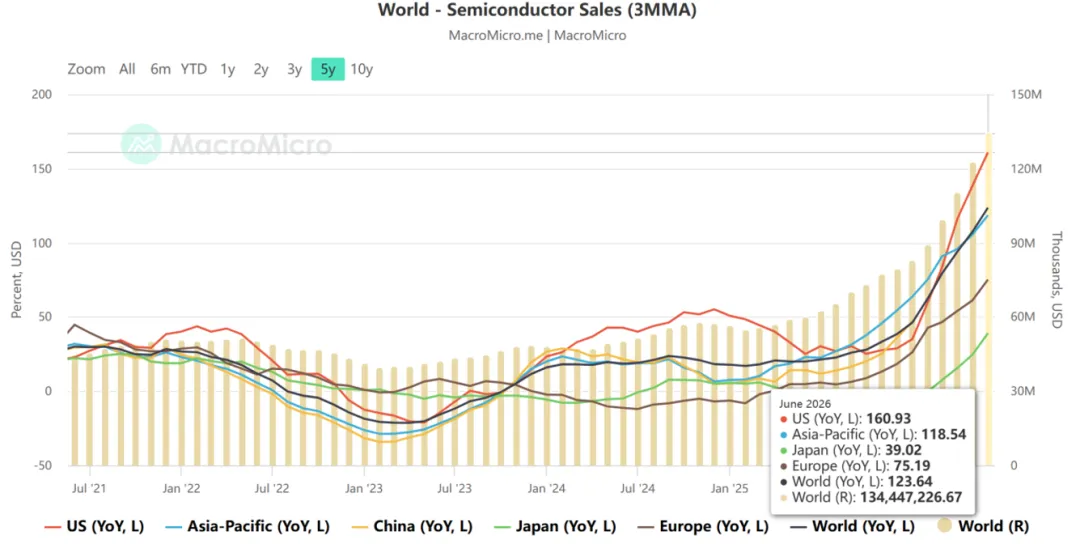
Put simply, this is no longer just a "recovery" — it is a structural upward cycle fully fueled by AI computing infrastructure. On the flip side, price hikes are spreading from advanced nodes to 8-inch power platforms, from high-end MLCCs to consumer-grade specifications, and from OEMs to component distributors.
Wafer Foundry
Structural Capacity Crunch, Price Uptrend Extends Until Late 2027
Signals from wafer foundries are clear. Hua Hong Semiconductor has operated near full capacity for nearly two years with persistently high utilization rates, and price increases have shifted from tentative local adjustments to widespread actions.
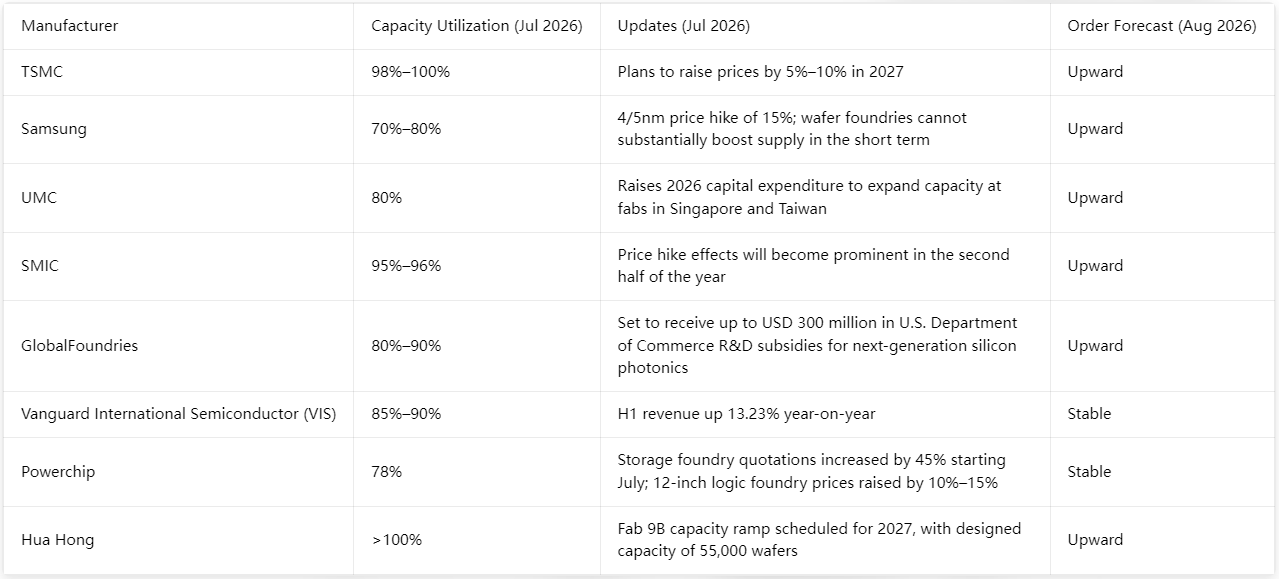
However, this cycle differs fundamentally from 2021. The 2021 boom saw simultaneous demand expansion and inventory build-up across mobile, PC, automotive and IoT sectors. The tightness in 2026 is structural: AI computing demand occupies advanced process capacity and spills over to squeeze 8-inch power and power platform capacity, while weak demand for traditional consumer electronics eases pressure on certain general-purpose chips.
The general sequence of price increases:
Advanced process nodes
8-inch power & power device platforms
12-inch specialty processes
Standard mature processes
HSBC raised forecasts for average capacity utilization at second-tier foundries including UMC, Vanguard, GlobalFoundries and SMIC in its late-June report — up 11% in 2026 and 27% in 2027, far above prior consensus estimates of 1% and 7%. Price improvements may last from the second half of 2026 through late 2027.
What does this mean for procurement? If your designs rely on power management ICs, power devices or analog chips built on mature 8-inch processes, bargaining power will be very limited in Q3.
Inventory Levels
Major OEM Inventories Hit 3-Year Lows, Gross Margins Rise
Average inventory days at leading semiconductor manufacturers fell by 4 days quarter-on-quarter in Q2 to 118 days — the lowest level in three years. Meanwhile, average gross margin climbed to 48.6%.
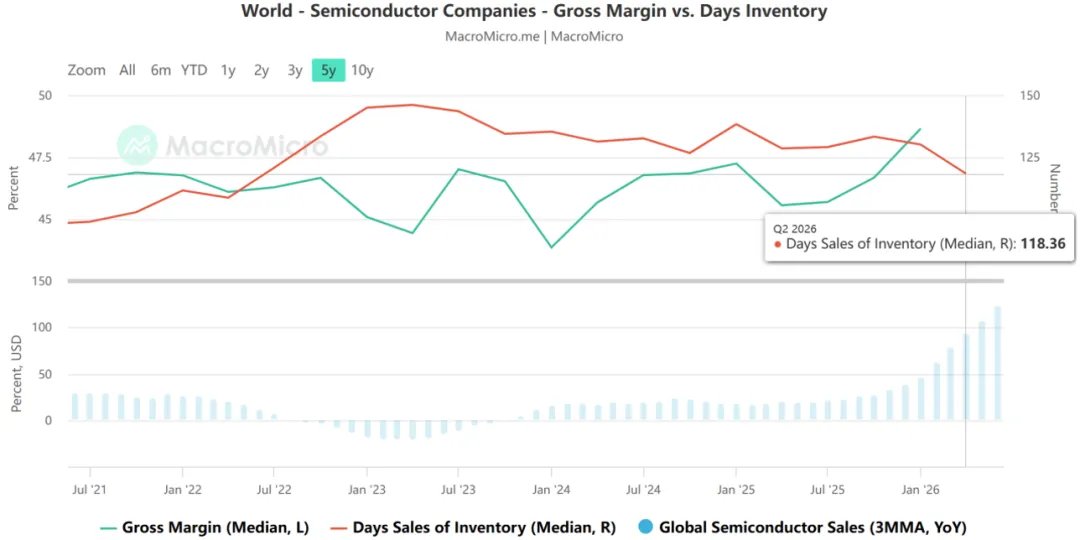
Global semiconductor sales have reached all-time highs while inventories keep declining. The supply-demand gap continues to widen.
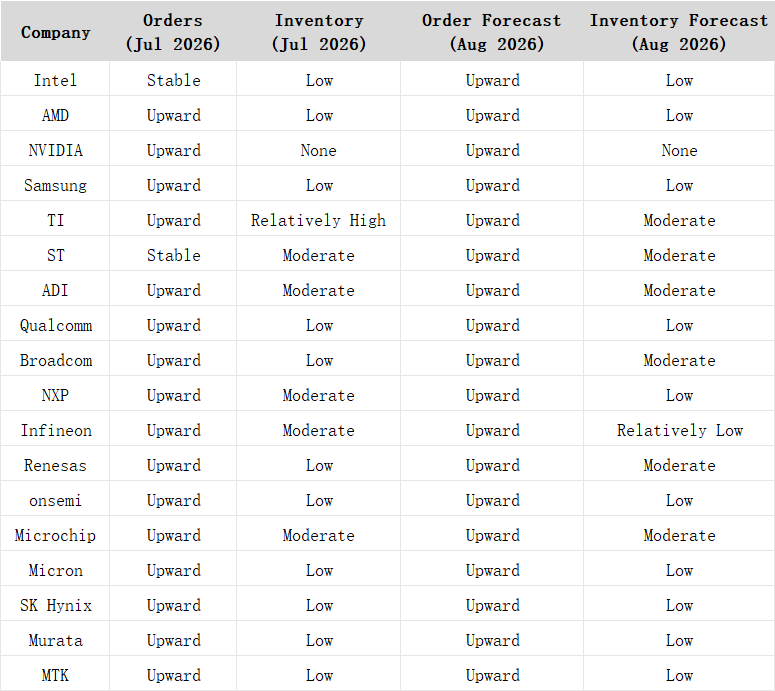
Brand dynamics show clear divergence:
TI: Relatively high inventory. Price hikes took effect July 1, potentially triggering order surges to deplete OEM stock. TI’s DC-DC converters (e.g. TPS54331) are undergoing a large-scale transition from 8-inch to 12-inch wafers, with lead times extended to 12–20 weeks and price increases already propagating through the market.
ST and ADI: Partial part availability leads to price volatility. Demand for ST’s MCUs (e.g. STM32F407VET6) softened in the traditional July–August off-season, with prices falling from early-year peaks.
NXP and Infineon: Low inventories and rising orders, making price hikes and extended lead times highly likely.
ONSEMI: Shortage conditions worsening.
Memory and MLCCs: Remain the most affected segments.
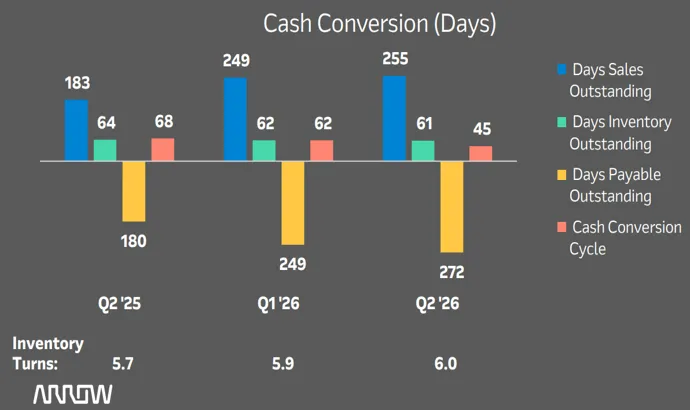
Financial results from two major international distributors confirm faster inventory turnover: Arrow’s inventory turnover improved from 50 days to 60 days,
while Avnet’s inventory turnover days plunged from 95 to 71.
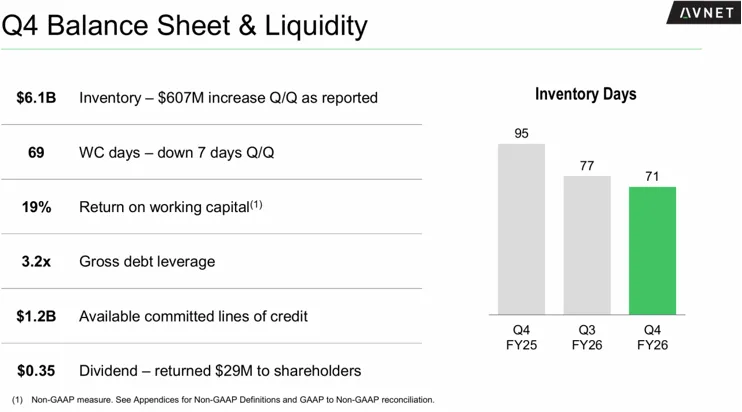
Inventory destocking among distributors is essentially complete.
Memory
HBM Fully Allocated, DDR Prices Keep Rising, NAND Faces Structural Divergence
Memory exhibits the strongest price elasticity within this market cycle.
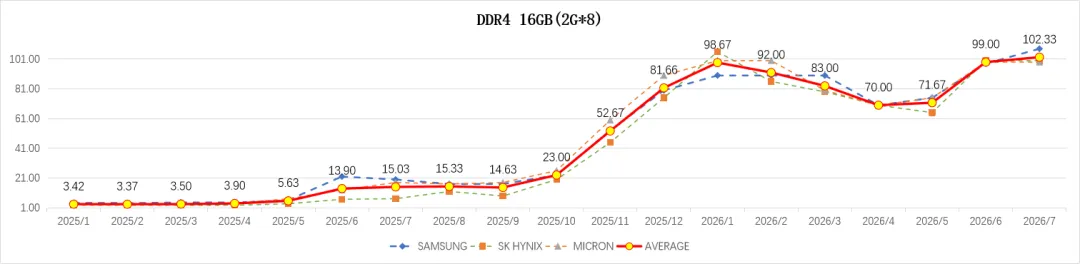
On the DRAM front, spot prices for Samsung DDR4 16Gb (2G×8) surged from below USD 4 in early 2025 to USD 102 by July 2026.
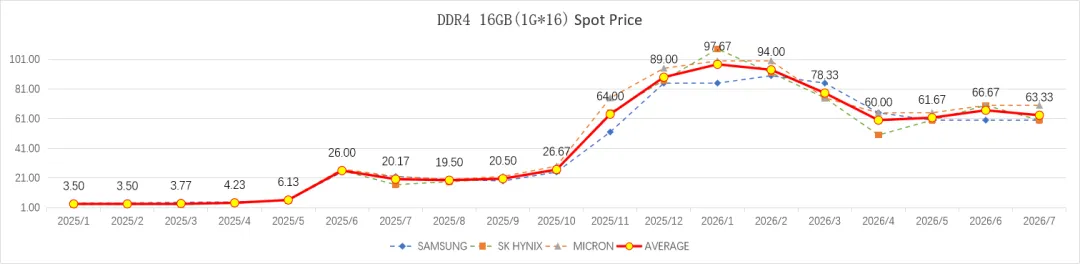
DDR4 16Gb (1G×16) jumped from USD 3.50 to USD 63. This is not just a percentage gain — it represents a roughly 20x price explosion.
Three core driving factors:
HBM capacity cannibalization. SK Hynix’s entire 2026 HBM capacity is committed, and most 2027 allocations have been locked in. HBM occupies 2–3 times more wafer area than standard DRAM of equivalent density, directly squeezing wafer supply for mainstream DDR4/DDR5.
Supply expansion fails to keep pace with demand growth. DRAM capacity growth is constrained by long equipment lead times (CoWoS packaging equipment lead times stretch into 2027, EUV lithography tools into 2028), while demand from AI servers and data centers continues accelerating.
Inventories remain at multi-year lows. Inventory metrics of the three major memory vendors (SK Hynix, Samsung, Micron) fell approximately 30% in Q2 2026 compared with Q4 2025.
Market conditions for NAND Flash differ significantly from DRAM. According to SMCC analysis, NAND capacity is expanding and supply-demand fundamentals are shifting. New capacity planned by multiple suppliers will ramp in H2 2027, with substantial volume contribution arriving in 2028. Supply conditions are gradually improving, so upward price pressure is milder than DRAM, though tight balance remains in the short run.
Key conclusion: The DRAM supply-demand imbalance will widen further in 2027, while the NAND market balance may start turning from late 2027 onwards.
MLCC
AI Demand Boosts High-End Grades; Price Hikes Spread from Japanese & Korean Manufacturers Industry-Wide
MLCC represents one of the segments seeing the broadest and steepest price increases in this cycle.
Murata: 15%–40% price increase implemented in April for AI and automotive high-spec models.
Yageo: Overall pricing across capacitor product lines lifted by 50% in July; consumer-grade variants rose 20%–40%, while popular high-capacitance AI models increased over 40%.
Samsung Electro-Mechanics, Taiyo Yuden and other Japanese/Korean manufacturers followed with price adjustments.
Demand data validates aggressive pricing momentum: AI server MLCC demand rises 87% YoY in 2026, with another 88% growth projected for 2027. A single AI server rack consumes 440,000–600,000 MLCCs, and inductors are also facing acute shortages.
Supply outlook remains challenging. The high-end MLCC market is highly concentrated among five Japanese/Korean suppliers (Murata, Samsung Electro-Mechanics, Taiyo Yuden, TDK, Kyocera). Capacity expansion cycles span 1.5–2 years, limiting new high-end supply coming online in 2026. Leading Japanese/Korean producers are reallocating wafer capacity toward high-capacitance AI server and automotive products, reducing supply of general medium/low-voltage grades.
Price trends for mainstream parts illustrate this shift: Samsung CL21A106KAYNNNE (10μF 0603) climbed from roughly ¥0.12 to ¥0.54 since early 2026, and CL21A226MAYNNNE (22μF 0603) increased from ¥0.19 to ¥1.30.
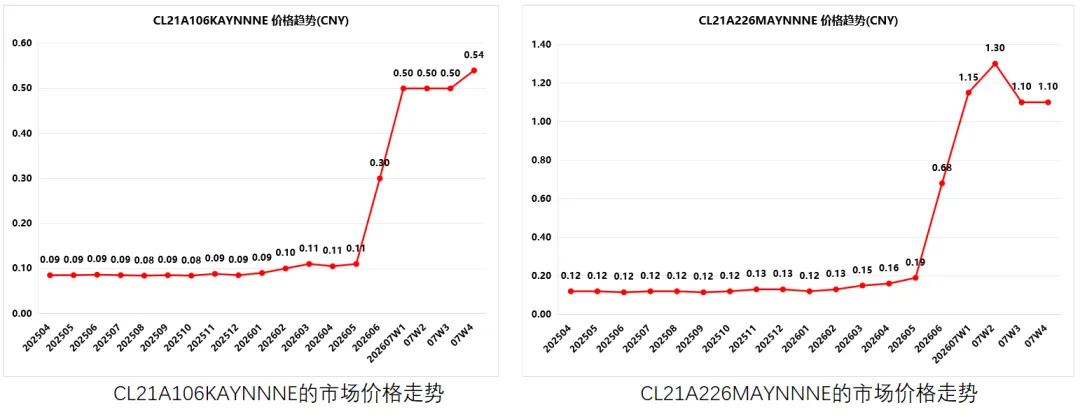
Price trends of CL21A106KAYNNNE and CL21A226MAYNNNE
Power Devices
AI Demand Competes for 8-inch Wafer Capacity; Two Rounds of Industry-Wide Price Hikes
In H1 2026, more than 20 global power device manufacturers including Infineon, TI and STMicroelectronics rolled out two rounds of price increases effective April 1 and July 1. Lead times for certain AI-focused power components extended to 40 weeks alongside sharp price growth.
The core tension stems from AI-driven competition for 8-inch wafer capacity:
Power devices predominantly rely on mature 8-inch wafers. TSMC is scaling back 8-inch power process allocation, while domestic 8-inch foundry capacity is captured by AI-related orders, continuously tightening wafer allocation.
Equivalent power devices fabricated on 8-inch wafers deliver superior cost performance versus 12-inch alternatives, lowering downstream willingness to migrate processes and further intensifying 8-inch capacity strain.
Silicon Carbide (SiC) production remains centered on 6-inch lines with slow capacity ramp, unable to absorb incremental demand in the short term.
Nevertheless, medium-to-long-term capacity surplus risks deserve attention. Numerous second-tier power device manufacturers and wafer foundries continue capacity expansion, with new volumes scheduled to ramp from Q4 2026 through 2027. Coupled with fierce industry competition, oversupply may emerge for low-end power devices, potentially forcing some smaller manufacturers out of the market.
Packaging & Test Capacity
Advanced Packaging Shortage to Persist Until At Least 2028
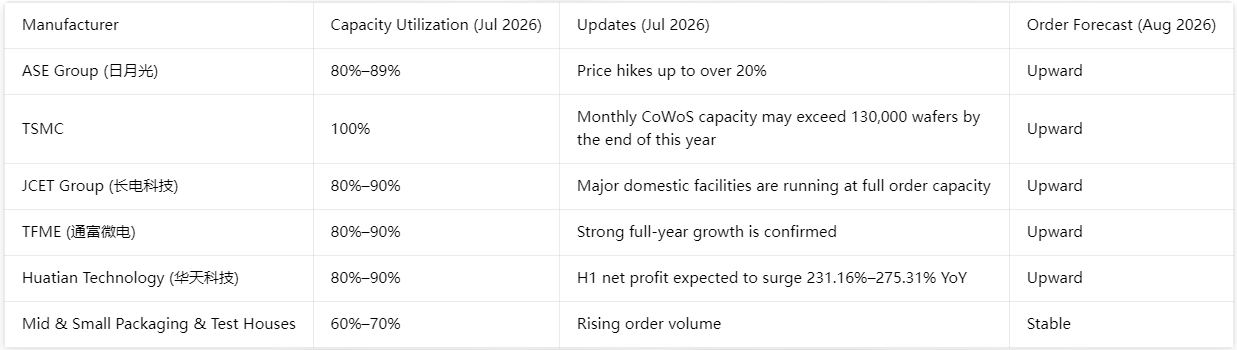
Packaging and test capacity presents a landscape of "structural shortage, overall full utilization and aggressive capacity expansion."
Combined demand from AI computing, HBM and Chiplet creates an advanced packaging capacity gap that will persist until at least 2028. Within mainland China, JCET’s XDFOI, TFME’s Chiplet packaging and Simgui’s 2.5D packaging support domestic AI chip development, though a 1–2 generation technology gap remains versus global leading players.
Three bottlenecks restrict capacity expansion: prolonged equipment lead times (lead times for some advanced packaging & test equipment exceed 12 months), insufficient production infrastructure (high-end cleanrooms require lengthy construction cycles), and tight supply of critical materials (high-end CC-Link substrates, ABF carrier boards).
Notably, 60%–70% of global packaging capacity is still wirebond and flip-chip oriented. Demand for automotive semiconductors, industrial MCUs, power management and IoT sensors maintains steady growth with healthy profit margins. Huatian’s layout in memory and automotive packaging may prove more resilient than widely anticipated.
SMCC
Market Summary & Procurement Recommendations
Overall, the core logic driving chip market dynamics in H2 2026 can be summarized as follows: The capacity absorption effect of AI computing infrastructure is propagating from advanced nodes toward 8-inch power platforms and 12-inch specialty processes. Q3 marks a critical window for spreading price hikes. With inventories at three-year lows and gross margins approaching 50%, OEMs retain strong pricing leverage.
Segment outlook: The DRAM supply-demand imbalance will widen further in 2027; meaningful relief for NAND supply pressure may not arrive until late 2027. High-end MLCC price increases will continue through at least 2027, constrained by expansion schedules of the five major Japanese/Korean vendors. Power devices remain tight in Q3, yet surplus risks emerge as second-tier capacity releases ramp in Q4. Advanced packaging capacity shortages will last until at least 2028.
For procurement teams, this means identifying your position along the price transmission chain early — either absorb price increases passively or lock in reasonable costs during available windows.
Faced with this wave of structural market volatility, SMCC leverages its big-data market platform to synchronize real-time updates on global OEM price adjustments, spot inventory and lead time fluctuations. We deliver part-level price trend analysis, excess inventory liquidation and global component matching services, serving customers across smart display, AI computing, industrial control, automotive electronics and IoT sectors. Amid ongoing shortages of power devices, MLCCs and memory, SMCC maintains spot inventory of mainstream models from Nexperia, TI, Samsung, Murata and other brands, supporting long-term order placement and urgent spot demands, helping enterprises stabilize supply chains and control procurement costs.
-
Everest Semiconductor’s product portfolio covers full-series audio ADC, DAC and CODEC chips, fully adapting to diversified application scenarios including smart speakers, soundbars, smart TVs, wearable devices, digital walkie-talkies and automotive electronic equipment.
-
In June 2026, global semiconductor market sales hit USD 134.45 billion, representing a 123.6% year‑on‑year increase and 16 straight months of sequential growth, standing at an all‑time high.
-
-
In June 2026, global semiconductor monthly sales reached USD 134.45 billion, a year-on-year increase of 123.6%, marking the 16th consecutive month of sequential growth.

Contact 10Marina Boulevard #47-01 Marina Bay Financial CentreTower 2 Singapore 018983 TEL:00852-6763-0779 E-mail:sales@smartcore-cloud.com
SOCIAL


Natural resources
